Burnt rainforest is a surreal landscape. To get the full effect, first picture yourself immersed in the deepest rainforest to which your imagination instinctively takes you. Towering Figs whose massive canopy is home to myriad lichens, lianas and epiphytes. Palms of effervescent green jostling for the sun. Luxuriant mosses and hypercolour fungi carpeting fallen timber on the forest floor. Crystal clear water gurgling down cobble-lined seeps. Deep leaf litter of golds and yellows, saturated from the rain and mists that daily sweep the forest.
Now, strip that same landscape of colour. Replace the greens with muted browns and greys. Erase the moss and fungi, and substitute the leaf litter for exposed, desiccated clay. Kill the palms, whose fronds hang limp, and sprinkle charcoal around the buttress roots of the now dead Figs. Swap the crystal-clear seeps for eroded gullies filled with silt and ash.
It is a confronting image, and one I personally couldn’t comprehend until I saw it with my own eyes. We were in the Main Range in south-east Queensland in September 2020; the first Spring following the devastating Black Summer fires that raged across eastern Australia in 2019/2020. Our purpose was to survey for an endangered rainforest frog that is one of many endemics of the Scenic Rim. On this particular day I was following Queensland’s frog champion-in-chief, Harry Hines, along a winding track through wet sclerophyll forest that was burnt severely by the fires the year before. Soon we reached the rainforest, where those extraordinary fires had punched deep into the normally fire-proof vegetation. While severe, the aftermath in wet sclerophyll forest hadn’t shocked me – sclerophyll forest burns, that’s why it is what it is. But rainforest? Fire kills rainforest, right? I felt I was witnessing the start of the end for these particular remnants. Remnants that had survived for millennia, in climate refugia that themselves felt on the cusp of disappearing.
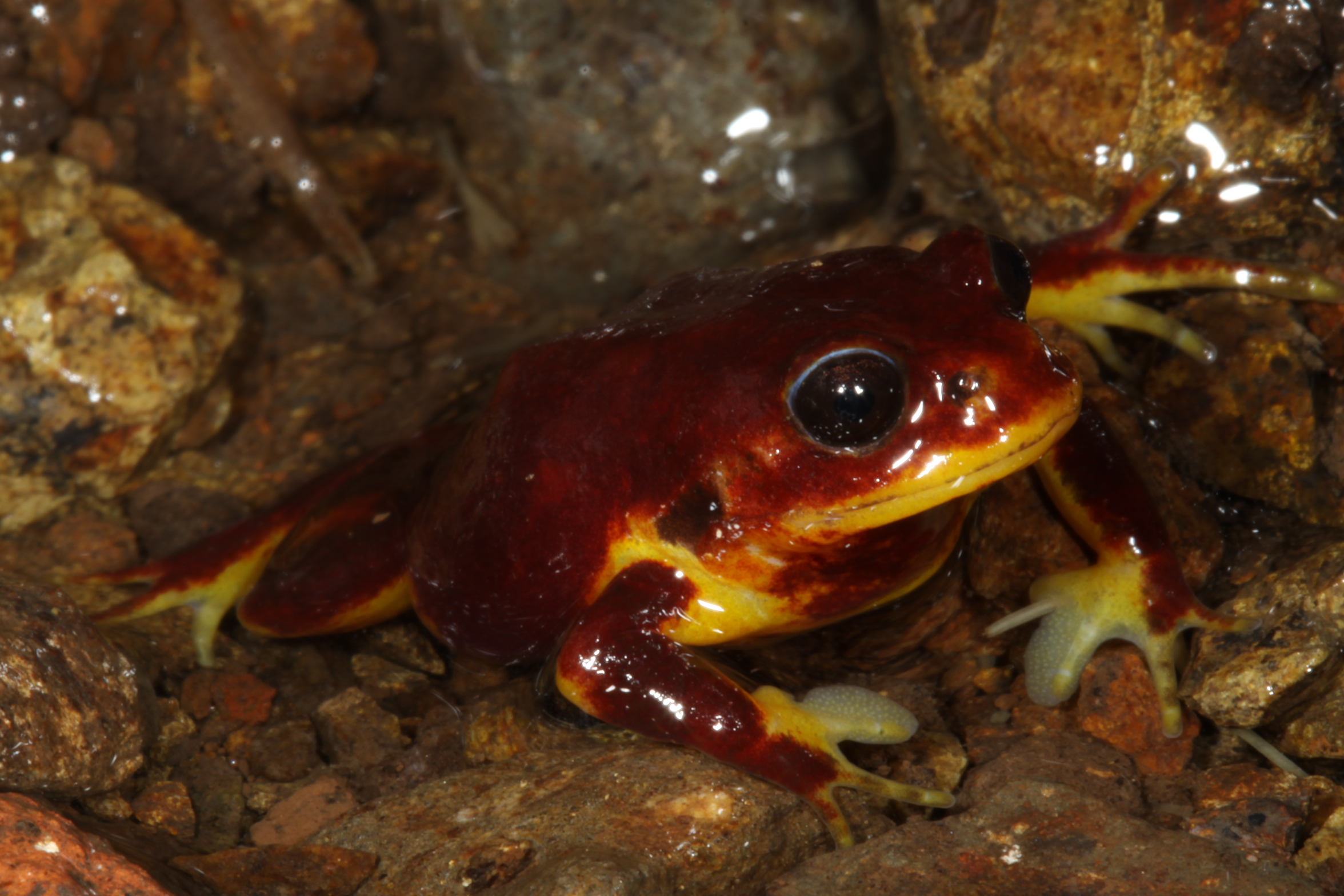
Our surveys that day were part of a wider effort to understand the impact of the Black Summer fires on threatened frogs. This particular project – funded by the NSW Government’s Saving our Species Program and the Australian Government’s Threatened Species Recovery Hub and Commonwealth Bushfire Recovery Program – focussed on the Mountain Frog (Philoria kundagungan) and two closely-related species, the Richmond Range Mountain Frog (Philoria richmondensis) and the then not-quite-described Mount Ballow Mountain Frog (Philoria knowlesi). A major aim was to re-survey sites for P. kundagungan and P. richmondensis that have been the focus of David Newell’s research group for some years, to enable comparison of occurrence and abundance post-fire with that observed pre-fire. My contributions to the field work were admittedly meagre, with the great majority completed by Harry and his team, and the monumental efforts of Southern Cross University’s Liam Bolitho.
My primary task, assigned to me by project co-lead Ben Scheele, was to analyse the resulting data and write up a report and paper describing the outcomes. Fast forward to today and that paper has finally been published. You can find it here.
So, what did we find? I’ll focus on the two species for which we obtained the most data. For P. kundagungan, we estimated some 30% of potential habitat for this species was burnt, and the data provided evidence of important effects on fire and the associated drought conditions on occupancy rates and abundance of calling males. Occupancy rates were down 19% from surveys in the 2016/2017 breeding season, and sites that were burnt were significantly less likely to support calling males post fire (as were those that remained drought affected). For the P. richmondensis, only 12% of potential habitat was burnt, and we did not find clear effects of fire on occupancy or abundance of calling males post-fire (in part, because much of the habitat that was burnt was in lower elevation areas that are generally less suitable). Like P. kundagungan however, there was clear evidence for drought impacts on this species, with important effects of site saturation extent on occupancy and abundance. Moreover, compiling the data for all survey seasons for this species (2012/2013, 2019/2020 & 2020/2021) showed that occupancy rates and abundance were significantly depressed immediately prior to the Black Summer fires when drought was at its zenith, but recovered somewhat in 2020/2021 following significant winter rainfall across the range of this species. Not surprisingly, drought significantly curtails breeding attempts in this species, which relies on saturated seeps in which to build its nests.
Three years on, spurred by a triple La Niña , the burnt rainforests of the Gondwana World Heritage Area are starting to recover. Their colour has returned, with a flush of new growth obscuring the more obvious signs of the fires. What’s more, evidence has accrued of the resilience of these systems to fire incursions; greater resilience than we once thought possible. These are encouraging signs, but studies such ours and myriad others on the impacts of the Black Summer fires, show that these blazes and the preceding intense drought will have a lasting impact. And we know from climate forecasts that intense droughts and resulting wildfires will threaten these landscapes again in the coming decades, perhaps repeatedly. So, we must prepare. For species like Philoria, we need to increase their resilience by reducing other threatening processes, like feral pigs, which destroy the fragile hydrology of their nesting sites and may prey directly on the frogs themselves. We can also minimise the risk of fire incursion to their rainforest seeps by careful management of fire in neighbouring habitat, and stemming the invasion of flammable weeds. And we can take direct action to respond when these steps aren’t sufficient, by establishing captive populations and pursuing releases to re-establish populations when they blink out, or reinforce populations weakened by fire or drought. In an exciting development, this is exactly what is being pursued by Dave Newell’s team at Southern Cross University, with support by the NSW Government’s Saving our Species Program.
Until the world curbs its CO2 emissions, conservation of many rainforest endemics will need to focus on these local scale actions. The overarching threat is ominous, but we do have levers to pull to bolster the resilience of exposed populations. Success will depend on the scale of investment, and – as always – plenty more of that is required.
 Geoff Heard's Research