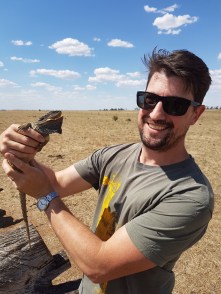
I have dual appointments at The Australian National University and The University of Queensland.
At ANU, I am a Research Fellow at the Fenner School of Environment and Society in the research group of Dr Ben Scheele. The overarching theme of our research is the spatial and temporal dynamics of declining species, through which we seek insights into population processes that can guide conservation planning. My projects usually lie at the intersection of applied ecology and herpetology, because I’ve been fascinated by reptiles and amphibians since I was a boy, and the obsession shows no sign of abating. Whatever the taxa, my aim is to provide insights and tools that can support practical, on-ground conservation decision-making. Some recent projects are listed below.
At UQ, I am a Science Advisor for the Threatened Species Index (TSX) at the Terrestrial Ecosystem Research Network (TERN) and an Affiliated Researcher with the Centre for Biodiversity and Conservation Science. The TSX integrates long-term monitoring data for Australia’s threatened and near-threatened species to estimate abundance trends. A key focus of my role is assisting to get the hard-won data of Australia’s ecologists into the TSX, including working with data providers to generate reliable time-series of abundance or occurrence rate from their data. Ultimately, I help to ensure that the TSX continues to provide accurate and up-to-date information on population trends for Australia’s imperilled species.
Contacts and social media:
- Email: Geoff.Heard@anu.edu.au | g.heard@uq.edu.au
- Flickr: https://www.flickr.com/photos/137559394@N07/
- Instagram: @gw.heard
Recent and current research projects:
- Range, niche and demographic shifts in frogs afflicted by disease: Chytridiomycosis in amphibians has demonstrated the ability of biotic interactions to drastically alter the distribution, niche and demography of species. We recently published a major paper on this phenomenon in Nature Ecology & Evolution led by Ben Scheele and Jarrod Sopniewski. Follow up work on the topic continues, with two recent papers: one in which we show that Australian frogs have contracted primarily towards their niche cores not margins due to chytrid (paper here) and another published with Ben, Matthijs Hollanders and Michael Scroggie, in which we dig into the demographic mechanisms underlying these niche shifts, using the pattern of decline in Green and Golden Bell Frogs and Growling Grass Frogs as a case study (paper here).
- Response of threatened frogs to the ‘Black Summer’ fires: Australia suffered unprecedented wildfires between Spring 2019 and Autumn 2020, with an estimated 10 million hectares burnt on the east coast and adjoining ranges. These fires were not only unprecedented in scale, but burnt landscapes that are normally immune from fire, including rainforest and ancient Antarctic Beech forest. Recently I worked with Ben Scheele, Dave Newell, Liam Bolitho and Harry Hines to assess the impacts of these fires on the Mountain Frog (Philoria kundagungan) and Richmond Mountain Frog (Philoria richmondensis) in northern NSW and south-eastern Queensland. The final report from this work can be found here and the resulting paper here.
- Environmental drivers of disease dynamics in frogs: Beginning with a paper in 2014, I continue to work on the effects of wetland microclimate and water chemistry on the impact of chytridiomycosis among threatened frogs (see here) and the potential of such relationships to inform manage options for the disease (see here). Additional studies have focused on: (i) the effects of elevation and canopy cover on chytrid prevalence and frog persistence in the rainforests of North Queensland (in collaboration with Sara Bell, Lee Skerratt and Lee Berger – paper here); (ii) the effects of environmental variables on chytrid infection dynamics in frogs of the NSW semi-arid zone (in collaboration with Anna Turner and Skye Wassens – papers here, here and here), and; (iii) a review paper on the potential for mitigation strategies focused on the environmental part of the host-pathogen-environment triangle (in collaboration with Ben Scheele and team, see here).
- Metapopulation and metacommunity dynamics of frogs: In collaboration with Michael Scroggie, Kirsten Parris, Michael McCarthy, Matt West and Peter Robertson, I continue research on the metapopulation and metacommunity dynamics of frogs across northern Melbourne, using a long-term occupancy dataset amassed since 2001. Our particular focus has been the threatened Growling Grass Frog; however, recent work sought to use hierarchical models to estimate the occupancy dynamics of the entire frog community.
 Geoff Heard's Research